
In traditional injection molding, finding the “ideal” processing window often looks like a game of tug-of-war. If you increase the injection pressure, you might solve a short-shot issue but accidentally create flash. If you lower the melt temperature to reduce cycle time, you might compromise the part’s structural integrity.
At AGS Technology, we believe that consistency isn’t found through intuition—it is engineered through data. The core of this data-driven philosophy is Design of Experiments (DOE) software.
What is DOE?
Design of Experiments is a systematic, mathematical method used to determine the relationship between the factors affecting a process and the output of that process. In injection molding, the “factors” are variables like melt temperature, mold temperature, injection speed, and hold pressure. The “outputs” are the physical characteristics of the molded part: dimensions, weight, strength, and aesthetic finish.
Moving Beyond One-Factor-at-a-Time (OFAT)
Most processors use the “One-Factor-at-a-Time” method, where they change a single setting and observe the result. While common, this method is fundamentally flawed because it ignores interactions. For example, the effect of injection speed on a part’s finish might change drastically depending on the current mold temperature.
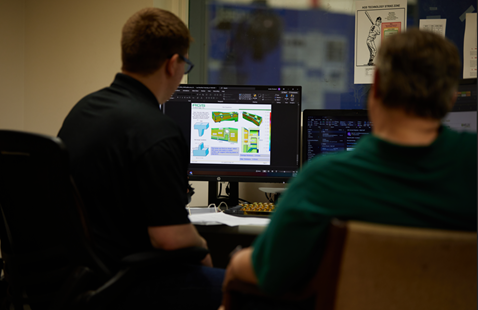
DOE software allows AGS engineers to run a series of controlled tests that vary multiple factors simultaneously. By analyzing these interactions, the software generates a Response Surface, a 3D map that visualizes the “Safe Operating Window.”
The AGS Engineering Workflow
Our integration of DOE software happens long before the press starts running at full capacity. The process typically follows these stages:
- Defining Objectives: We identify the critical-to-quality (CTQ) dimensions and physical properties required for the specific application.
- Factor Screening: Our engineers select the most influential variables for the specific resin and geometry.
- Optimization: The DOE software identifies the specific combination of settings that results in the lowest standard deviation. This is the “Ideal State.”
Why It Matters for the Customer
The primary benefit of DOE-optimized molding is predictability. When we use a mathematical model to set our processes, the results are remarkably stable.
- Faster Speed-to-Market: By identifying the ideal conditions early, we reduce the time spent in the sampling and approval phase.
- Reduced Waste: DOE helps us find the most robust process window, meaning the process can handle slight fluctuations in material viscosity or ambient factory temperature without producing scrap.
Conclusion
At AGS Technology, we don’t just “mold parts”; we manage variables. By leveraging DOE software, our engineering team replaces the art of molding with the science of optimization. This commitment to technical rigor ensures that every part leaving our facility meets the highest standards of precision and durability, providing our clients with the confidence that their designs will perform exactly as intended.